
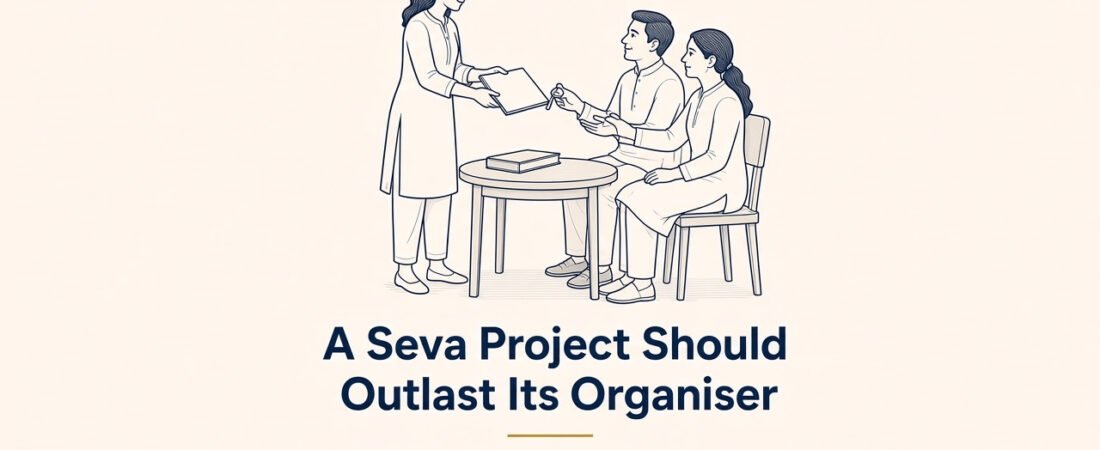
(Illustrative scene. The group, the people and the details are fictional.)
For six years, Sunita has run a Gita study circle on Saturday evenings. About twelve people come regularly. She books the community hall, and the booking runs until March. She keeps a small group fund of ₹18,000, partly in a cash box and partly in her own UPI account. She knows which members need a reminder call, which reader stumbles on Sanskrit and which one always brings the tea.
In six weeks she is moving to another city.
Her first thought is that the circle will simply end. Her second, more uncomfortable thought is that she never wrote any of it down.
Short answer: A seva activity outlasts its organiser when what was entrusted is written down, roles are shared before they are needed, a successor is prepared in stages, and the handover is done openly enough that others can check it. If no one can take over, pausing or closing honestly is better than leaving the work to fade. These steps are a modern application of old ideals, not a scriptural rule.
Seva is held in trust
Seva, service offered without seeking a return, often begins with one person’s energy. That is its strength and its risk. The more a project depends on one person, the more it carries that person’s absence when they leave.
Akhand Hindu Samiti’s own leadership principle puts it plainly: “No individual should become indispensable to the organization. The objective is to build institutions that outlast their founders.” We understand leadership as stewardship rather than status. A steward looks after something that belongs to others, and one day hands it on.
Bharata and the sandals: a picture of holding in trust
The Vālmīki Rāmāyaṇa has one of the most moving images of stewardship in Hindu literature. After Rama leaves for the forest, his brother Bharata agrees to govern Ayodhya in his place, but only as a keeper.
In the English translation by the Rashtriya Sanskrita Vidyapeetham, Tirupati, hosted on Heritage IIT Kanpur, Bharata says: “My brother gave me this kingdom as a trust” (2.115.14). He places the sandals “held in trust on his head” (2.115.15). Later he “reported everything relating to the kingdom to the sandals first” (2.115.25), while living at Nandigrama “longing for the return of Rama” (2.115.24).
The word for “as a trust” is sannyāsavat. Sannyāsa often names the renunciant’s vow, but here, as the site’s word-by-word gloss shows, it carries the sense of a deposit held in trust: something given into your keeping that is not yours to own. (A note on numbering: Heritage IIT Kanpur follows the Southern recension, so other editions may number these verses differently.)
Bharata does not pretend the kingdom is his. He governs carefully, he reports, and he keeps the real owner in view. That is the attitude a handover needs. The hall booking, the fund and the members’ trust were never Sunita’s alone.
Teaching passed on by steps
The Bhagavad Gita opens its fourth chapter with a line of transmission. In K. T. Telang’s translation (Sacred Books of the East, vol. 8), Krishna says the teaching passed from the sun to Manu, and from Manu to Ikshvaku: “Coming thus by steps, it became known to royal sages” (4.1–2).
The verse is about a spiritual teaching, not about running a study circle. Our application is modest. What matters tends to pass on by steps, through people prepared to receive it. It rarely survives a single abrupt hand-off.
The Gita also says why the manner of stepping back matters: “Whatever a great man does, that other men also do. And people follow whatever he receives as authority” (3.21, Telang). An organiser who hands over openly shows the group how responsibility is held. One who disappears shows something else.
When knowledge sits with one person (an analogy)
Software developers have a blunt name for this risk: the “truck factor”, the smallest number of people who would have to leave (or, in the grim joke, be hit by a truck) before a project stalls. A 2016 study by Guilherme Avelino and colleagues estimated it for 133 popular open-source projects on GitHub and found that, in many of them, essential knowledge was concentrated in very few people.
A study circle is not a software project, and that study’s figures say nothing about seva groups. As an analogy, though, it is useful. Ask of your own work: if I left tomorrow, how many people would know how it runs?
The continuity register: the framework
The continuity register is a working tool of our own, not a teaching from any text. It is one page, or one shared document, with a row for each activity you run. Fill in these columns:
| Column | What to write | Sunita’s example (illustrative) |
|---|---|---|
| Continue, pause or close | The honest decision for this activity | Continue the Saturday circle |
| Commitments to others | Promises already made | Hall booked until March; a reading planned for next month |
| Entrusted resources | Money, keys, books, equipment held for the group | ₹18,000 fund (cash box and her UPI); the hall key; shared books |
| Knowledge only one person holds | Things that live only in your head | Hall manager’s preferences; which members need a reminder call |
| Contacts and personal data | Whose details you hold, and whether they agreed to share them | Twelve members’ phone numbers |
| Role and backup | Who does it now, and who can step in | Sunita leads; Rakesh and Lata as co-coordinators |
| Handover evidence | What shows the handover happened | Signed cash count; written note of the UPI transfer; hall booking moved |
| Review | When the group checks again | One month after Sunita leaves |
The register does two jobs. It turns what you know into something others can see, and it makes the handover checkable rather than a matter of memory.
A six-week handover, step by step (illustrative)
Week 1: Tell the group, and decide together. Sunita announces her move early and asks whether the circle should continue, pause or close. The group decides to continue.
Week 2: Fill in the register. She writes down what only she knows: the hall contact, the booking terms, the reading plan.
Week 3: Share the roles. Two members agree to co-coordinate, so no single person becomes the new point of failure.
Week 4: Let them lead while she is still there. The co-coordinators run a session while Sunita watches and helps only when asked.
Week 5: Hand over money and contacts openly. Two people count the cash together and sign a short note of the amount. The balance in her personal UPI account is transferred to wherever the group agrees. Before passing on anyone’s phone number, she asks each member if they are happy for it to be shared.
Week 6: Step back. Sunita attends as a member, not a leader. The group fixes a date to review the arrangement one month later. After that, she steps back fully.
About money, records and contact details
As of November 2026. This is general information, not legal, tax or financial advice.
Rules on handling group money, bank accounts, registration, tax and personal data depend on your circumstances and can change. For anything beyond a small informal fund, speak to your bank and to a qualified chartered accountant or lawyer before you act. As good practice, keep group money separate from personal money where you can, record every transfer, have two people present when cash is counted, and share personal contact details only with the person’s agreement, and only as much as is needed.
If no one can take over
Sometimes no successor comes forward. That is not a failure of the group. Then the honest choice is to pause or to close: tell everyone clearly, return or redirect any money as the group agrees, cancel or transfer bookings, and thank people for what was built. A clear ending honours the work. A slow fade leaves people unsure what happened to something they cared about.
Right action does not depend on a perfect result. Our guide to dharma and karma explores how doing the right thing relates to what follows from it.
Frequently asked questions
Is stepping back a failure of commitment?
Not when it is done well. Handing over carefully is itself a commitment: to the people the work serves, and to the work outlasting you.
What if nobody wants to take over?
Share the role between two or three people, and make it smaller if needed. If that still does not work, pause or close openly rather than letting the activity drift.
What should happen to the group’s money?
Count it with a witness, record it in writing, and move it to wherever the group agrees. For accounts, registration or tax questions, ask your bank and a qualified adviser. This is general information as of November 2026, not legal advice.
Can I share the group’s contact list with my successor?
Ask members first, and share only what is needed. Some may prefer to give their details to the new coordinator themselves.
Continue learning
If you would like to keep learning about Hindu thought and how it meets everyday life, and to talk it over respectfully with others, you are welcome to find us at akhandhindusamiti.com.
Sources: Vālmīki Rāmāyaṇa 2.115.14–16, 24–25, English translation by Rashtriya Sanskrita Vidyapeetham, Tirupati, via Heritage IIT Kanpur (Southern recension numbering); The Bhagavadgītā, tr. K. T. Telang, SBE 8 (ch. 3, ch. 4); Akhand Hindu Samiti Brand Profile, Leadership principle; G. Avelino, L. Passos, A. Hora and M. T. Valente, “A Novel Approach for Estimating Truck Factors”, ICPC 2016 (arXiv:1604.06766).