
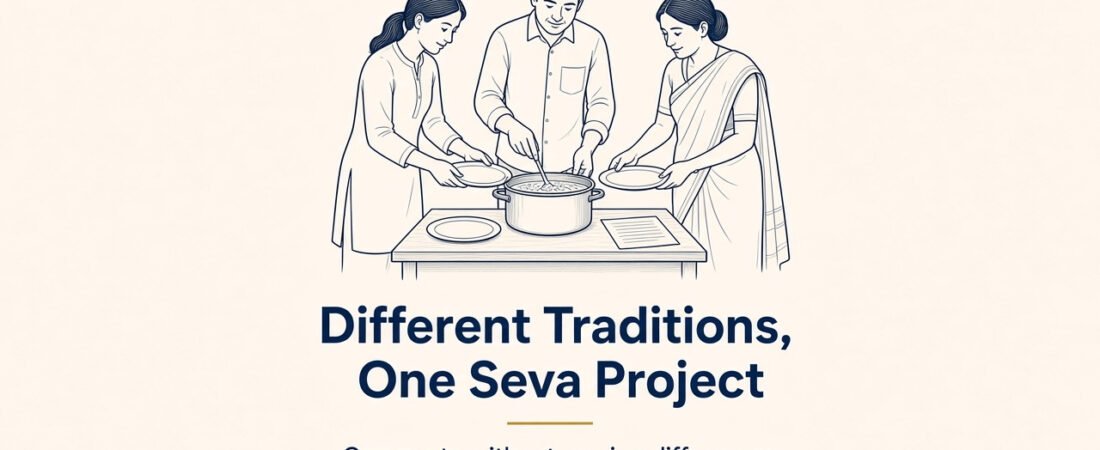
(Illustrative scene. The group, the people and the details are fictional.)
It is a Sunday morning outside a city hospital. Twelve volunteers have agreed to serve a simple meal to patients’ attendants: the relatives who sleep on benches and in corridors while someone they love lies on a ward. The volunteers come from three different traditions. By the second week, three questions have come up.
Should each shift begin with an aarti? Can the dal have onion and garlic, when some volunteers neither eat nor cook with them? And may one volunteer place small booklets about her tradition beside each plate?
Nobody is being difficult. Each question comes from something a person sincerely holds.
Short answer: People from different sampradayas can serve together without pretending their differences are unreal. They do not need to agree on doctrine. They need a shared purpose and clear working terms: what the group shares, what it does not require of anyone, who decides what, and how disagreement is handled. Scripture can shape the spirit of the work. The written agreement itself is a modern working tool, not scripture.
First, three words
Seva is service offered to others without seeking a return. Here it means practical work: cooking, serving, cleaning up.
A sampradaya is a tradition of teaching handed down through a line of teachers, with its own texts, practices and disciplines.
Dāna is giving, whether food, time, money or care.
Speaking together is not the same as believing alike
The last hymn of the Rig Veda (10.191) is often quoted at gatherings. In Ralph T. H. Griffith’s translation, verse 2 begins: “Assemble, speak together: let your minds be all of one accord.” Verse 3 says: “A common purpose do I lay before you.” Verse 4 closes: “United be the thoughts of all that all may happily agree.”
Notice what the hymn asks for. People gather, speak together and hold a common purpose. Our reading is that this describes people coming together around shared work and a shared resolve. It does not spell out a single doctrine everyone must hold, and it is not evidence that all traditions teach the same thing. A group can share a purpose (“feed the attendants well, every Sunday”) while its members keep their own understanding of why they serve.
Akhand Hindu Samiti puts the principle in one line: “Unity should not require uniformity.” Respect for differing sampradayas is part of how we try to work. Differences between traditions are real, and they deserve to be named honestly, not smoothed over with “all paths are the same”.
Why food, and why the manner of giving matters
The Taittirīya Upanishad has a short, practical passage on food. In F. Max Müller’s translation (Sacred Books of the East, vol. 15), the ninth anuvāka of the third vallī opens: “Let him acquire much food, that is the rule.” The tenth begins: “Let him never turn away (a stranger) from his house, that is the rule.” It goes on: “If he gives food amply, food is given to him amply. If he gives food fairly, food is given to him fairly. If he gives food meanly, food is given to him meanly.”
This passage is about a householder and a guest. It does not command anyone to run food drives. Applying it to a hospital meal is our reading. Even so, the spirit carries over: the stranger at the door, or on the corridor bench, is to be fed, and the manner of giving matters.
The Gita makes the manner even plainer. In K. T. Telang’s translation (SBE vol. 8), a good gift is one “given, because it ought to be given, to one who (can) do no service (in return)” (17.20). A dark gift is one given “without respect, and with contempt” (17.22). One caution. The same verses speak of a “(proper) person”, and that phrase should not become a reason to turn some people away. For a group serving tired relatives in a corridor, the test that matters is respect: no one is fed with condescension, and no one is made to earn a plate.
The Gita also describes the person who serves well. The devotee dear to Krishna “hates no being” and is “friendly and compassionate” (12.13, Telang). That is a good standard for the volunteers’ conduct toward one another, as well as toward the people they feed.
Lokasaṅgraha: work that holds people together
The Gita has a word for acting with the wider community in view: lokasaṅgraha, a holding-together of the world. Translators render it differently. Telang gives “having regard also to the keeping of people (to their duties)” (3.20) and “wishing to keep the people (to their duties)” (3.25). Edwin Arnold’s verse translation, The Song Celestial (1885), renders the first passage as “for the upholding of thy kind, Action thou should’st embrace.”
In the Gita the teaching concerns why a wise person still acts. Our application is modest. How a mixed group serves together is itself an example to others. A team that settles its differences calmly and keeps serving teaches something by doing so.
A lesson borrowed from the commons (an analogy)
The economist Elinor Ostrom studied communities that manage shared resources such as forests, fisheries and irrigation systems. In her 2009 Nobel lecture she listed features common to long-lasting arrangements, including clear boundaries, “collective-choice arrangements” in which most of those affected can help make and change the rules, and “rapid, low-cost, local” ways to resolve conflict. She also warned that “one-size-fits-all” policies are not effective, and said that “best practices” might have been a clearer name for her design principles.
A Sunday meal is not a fishery, so this is an analogy, not evidence. The analogy is still useful. Groups tend to last when people know what they have signed up for, help shape the rules, and have a simple way to raise a problem before it hardens.
A shared seva agreement: the framework
This is a working tool of our own, not a teaching from any text. It fits on one page. Write it together, in the group’s first or second week.
| Section | The question it answers | In the Sunday example (illustrative) |
|---|---|---|
| Purpose | What are we here to do? | Serve a clean, filling meal to patients’ attendants every Sunday. |
| What we share | What do we all agree on? | Respect for those we serve; no one is turned away; food served with care. |
| What we do not require | What will no one be asked to do or believe? | No one is asked to adopt another tradition’s worship, food rules or teacher. |
| Respectful participation | How do we treat each other’s practices? | Each person’s discipline is respected; no one is mocked or pressed to explain it. |
| Decision boundaries | Who decides what? | The group decides the menu and the shift format together; personal practice stays personal. |
| Disagreement route | How do we raise a problem? | Raise it with the two shift coordinators that week, not on the serving line. |
| Review | When do we check this again? | After one month, then as needed. |
The third row matters most. “What we do not require” tells every volunteer that joining will not cost them their own tradition.
How the Sunday group settled it (illustrative)
Back to the hospital. The group met after the second shift and worked through its three questions.
- Onion and garlic. The menu became onion- and garlic-free, so everyone could cook and serve with a clear conscience.
- Aarti. The hospital hall had its own rules, so the group followed those, and began each shift with a short silent pause. One volunteer felt a silent pause was not enough. She was invited to lead her own prayer before the shift, for anyone who wished to join.
- Booklets. Nothing was placed with the plates. A separate, clearly optional table held material for anyone who asked. Attendants came for a meal, not a message.
- Review. Everyone agreed to look at the arrangement again after a month.
Not everyone was fully satisfied. One volunteer decided the format was not right for her and stepped back. The group thanked her and let her go without pressure or blame. That is part of cooperating without erasing differences: sometimes the honest outcome is that one person serves elsewhere.
What the agreement is not
It is not scripture, and it does not claim scriptural authority. It does not say that all traditions teach the same thing, and it does not settle any question of doctrine. It is a page of working terms that lets people with real differences do good work side by side.
If you want to go deeper into why the shared ethic and one’s own duty can pull in different directions, our guide What Does Sanatana Dharma Mean? explores it. For how right action and its consequences fit together, see Dharma vs Karma.
Frequently asked questions
Doesn’t serving together mean all traditions are really the same?
No. Traditions differ in real ways. Serving together means sharing a purpose and working terms, not claiming identical beliefs. “Unity should not require uniformity.”
What if a group practice goes against my own discipline?
Say so through the agreed disagreement route. A good agreement lists what no one is required to do. If no arrangement fits, stepping back respectfully is a legitimate choice.
Can I share my beliefs while doing seva?
Your conduct already shares a great deal. Keep the service itself free of any message, so that no one feels their meal comes with conditions. If the group agrees, a separate optional space can hold material for those who ask.
Is the seva agreement taken from scripture?
No. It is a modern working tool. Scripture, such as the Gita’s teaching on giving with respect, can shape its spirit, but the agreement’s wording is the group’s own.
Continue learning
If questions like these interest you, you are welcome to keep learning and to discuss them respectfully with others at akhandhindusamiti.com.
Sources: Rig Veda 10.191, tr. Ralph T. H. Griffith (sacred-texts); Taittirīya Upanishad 3.9–3.10, tr. F. Max Müller, SBE 15 (3.9, 3.10); The Bhagavadgītā, tr. K. T. Telang, SBE 8 (ch. 3, ch. 12, ch. 17); Edwin Arnold, The Song Celestial, ch. 3 (sacred-texts); Elinor Ostrom, Nobel Prize lecture, 8 December 2009 (PDF).